Sushi Push vs Traditional Sushi Boxes: Which Packaging Drives More Sales?
- Share
- publisher
- suka
- Issue Time
- Mar 5,2026
Summary
Compare sushi push pop up tubes vs traditional sushi boxes with a B2B framework, measurable sales drivers, and food-grade BRC compliance. DHPBOXES is a SUKA Sushi supplier in China. MOQ 1000 pcs. Get a quote.
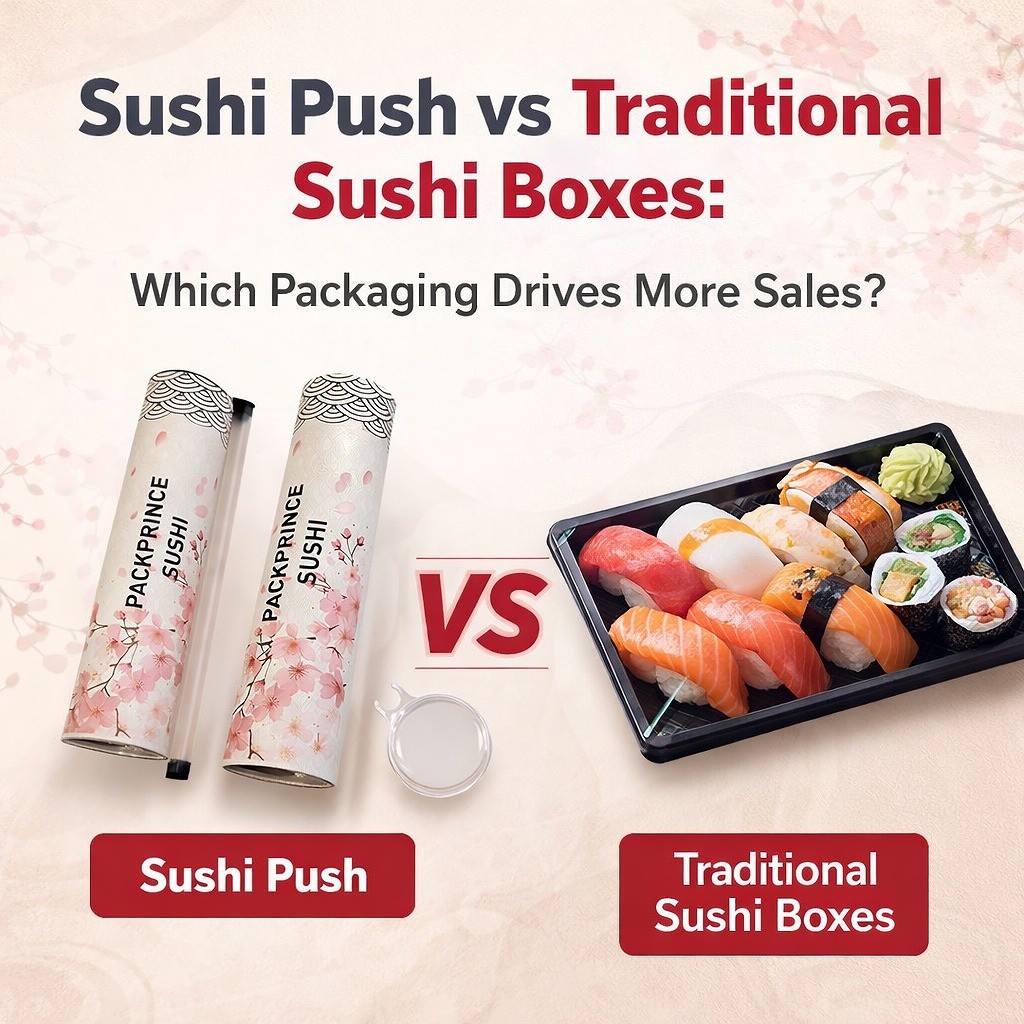
Sushi Push vs Traditional Sushi Boxes: Which Packaging Drives More Sales?
A B2B decision guide for sushi brands, restaurants, and food retailers — with a practical comparison framework, measurable sales drivers, and manufacturing details from DHPBOXES.
Packaging is no longer “just protection.” In modern food service, it influences attention, portability, perceived value, customer behavior, and repeat purchase. This is exactly why sushi push packaging (also called sushi push pop up tube packaging or sushi paper tube packaging) has become a high-impact alternative to traditional sushi boxes in takeaway and on-the-go scenarios.
As a custom paper tube packaging manufacturer, DHPBOXES supports sushi brands from concept to mass production. We are a long-term supplier for SUKA Sushi in China, producing food-safe sushi push tubes built for real-world selling environments.
Key factory notes: Mold size 210mm × 51mm · BRC food-grade compliance · MOQ 1000 pcs · Custom CMYK printing · Structural optimization and sampling available · Welcome to inquire for pricing and lead times.
Article Index
1) The Market Shift in Sushi Packaging
Traditional sushi boxes are familiar, stackable, and efficient for dine-in or “desk eating.” But the fastest-growing demand comes from takeaway counters, convenience retail, and mobile consumption — where the packaging itself must help the product sell. In these environments, the format matters:
- Attention economy: Packaging competes for a 1–3 second glance in store or in hand.
- On-the-go behavior: One-hand usability and spill resistance influence customer satisfaction.
- Shareability: A “new experience” increases social posting and organic reach.
- Brand signal: Premium look can justify premium pricing and improve perceived value.
That’s why more brands adopt sushi push pop up tube packaging as a sales-focused format — not just a container.
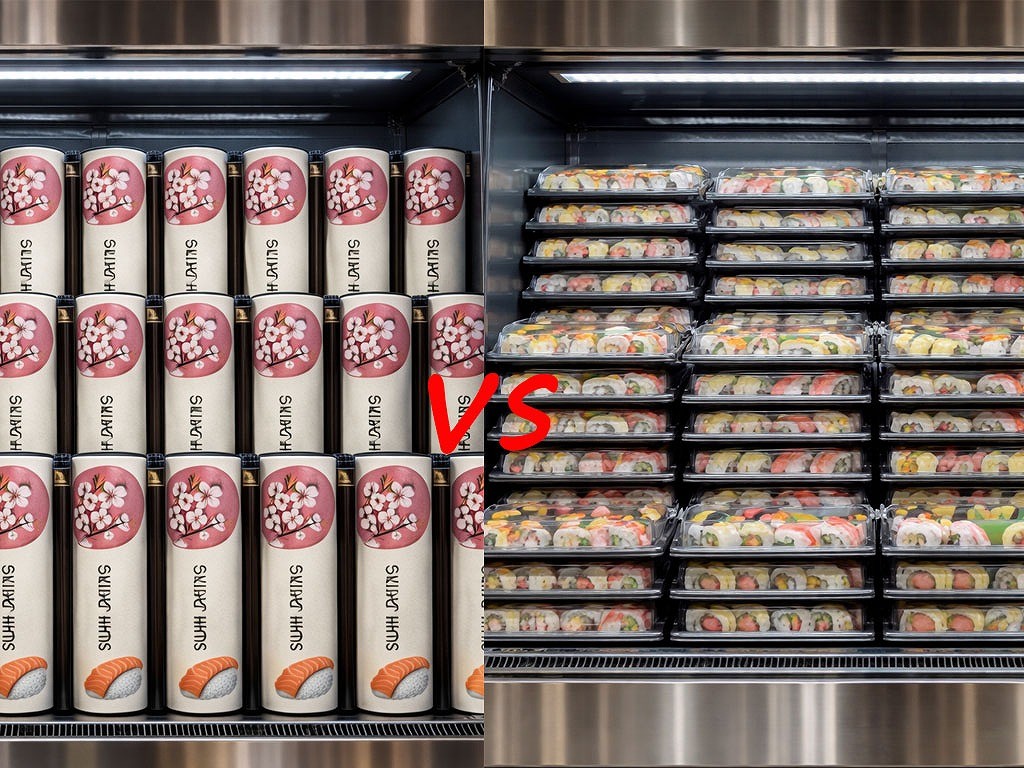
2) What Is Sushi Push Packaging?
Sushi push packaging typically uses a cylindrical paper tube with an internal push-up mechanism. The consumer pushes from the bottom to raise the product for easy eating. Compared with opening a flat-lid box, the experience is more interactive and often perceived as more “premium” and “fun.”
In B2B terms, the push tube format functions like a portable product display: it stands upright, features 360° branding, and is designed for customer movement — ideal for takeaway windows, food trucks, mall kiosks, and convenience-style retail.
Where it wins
- Impulse purchase and novelty
- On-the-go convenience
- Premium branding opportunities
- Strong social-media sharing behavior
Where boxes still matter
- Classic presentation for dine-in
- Large assortments / combo sets
- High stacking efficiency in storage
- Traditional “sushi box” expectations
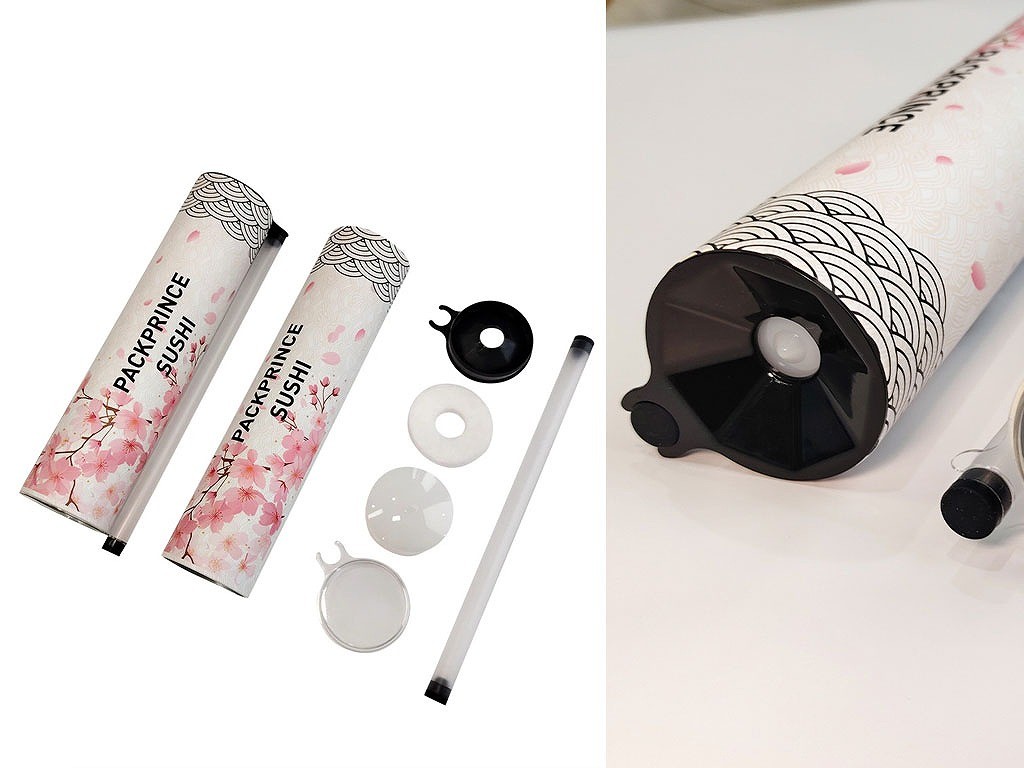
3) Sushi Push vs Traditional Sushi Boxes: A Comparison Framework
Instead of debating “which is better,” high-performing brands use a decision framework based on sales goals, channel, and customer behavior. Use the comparison below to evaluate both formats quickly.
| Decision Factor | Sushi Push (Paper Tube) | Traditional Sushi Boxes |
|---|---|---|
| Sales role | Attention + experience + brand recall | Familiar utility + portion organization |
| Customer use | One-hand, mobile eating | Best on a table/desk |
| Branding area | 360° wrap printing (high visibility) | Top + side panels (limited by structure) |
| Perceived value | Often reads as “premium product” | Standard meal packaging |
| Best for | Signature rolls, viral/limited items, takeaway channels | Assortment trays, catering, traditional presentation |
4) Quantifiable Sales-Driving Factors
“Drives more sales” should be measurable. While results vary by market and execution, packaging impacts sales through trackable metrics. Below are practical, quantifiable drivers that brands can measure during a 2–6 week pilot.
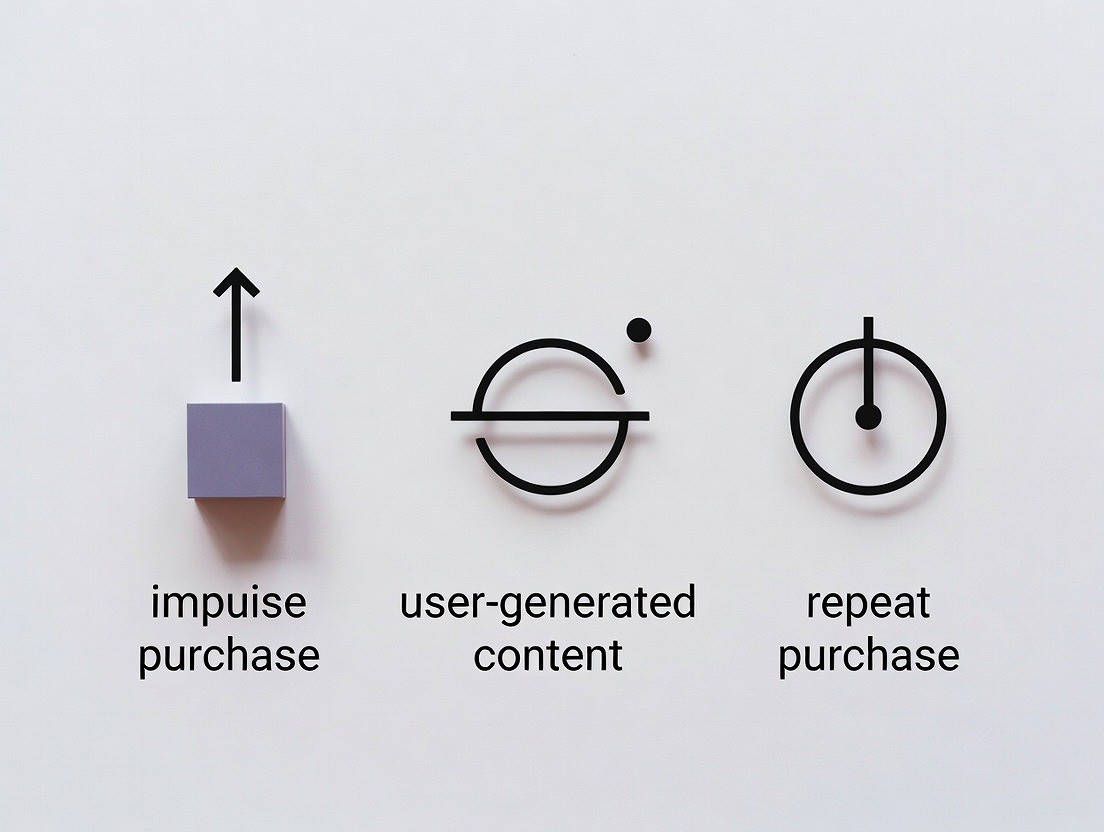
A) Impulse Purchase Lift
Track add-on purchases at takeaway counters. Upright tubes act like “mini displays,” often improving first-time trial for signature items.
Suggested KPI: add-on rate (%) for the promoted roll.
B) Social/UGC Exposure
Interactive opening increases the chance of photos/videos. More UGC = more organic reach, especially for newer brands.
Suggested KPI: posts/mentions per 100 orders.
C) Brand Recall
360° branding increases memory. This supports repeat purchases and improves recognition in multi-brand marketplaces.
Suggested KPI: repeat order rate within 30 days.
D) Premium Pricing Power
Premium packaging can justify premium items (limited edition, chef’s signature roll, seasonal SKU).
Suggested KPI: gross margin change vs baseline packaging.
For SUKA Sushi, the push tube format is not used randomly. It is treated as a branded SKU format — designed to stand out, travel well, and encourage trial. That packaging-led behavior is what turns “attention” into “orders.”
5) Scenario Fit: When Tubes Beat Boxes (and When They Don’t)
A common mistake is choosing one format for every product. The best approach is channel-based packaging strategy. Below is a practical guide:
Best use cases for sushi push tubes
- Takeaway counters and mall kiosks
- Street food / pop-ups / food trucks
- Signature roll promotions
- New store launches and PR moments
- Products aimed at younger, social-first audiences
Best use cases for traditional sushi boxes
- Large platters / assorted sets
- Dine-in serving formats
- High-volume catering and events
- Products requiring multiple compartments
- Operations where stacking efficiency is the top priority
6) Branding & Shelf Impact: The “Walk-by” Advantage
In real-world retail, customers often decide before reading a menu. Packaging that looks like a “product” (not just a container) can gain a walk-by advantage. Sushi push tubes naturally support this because:
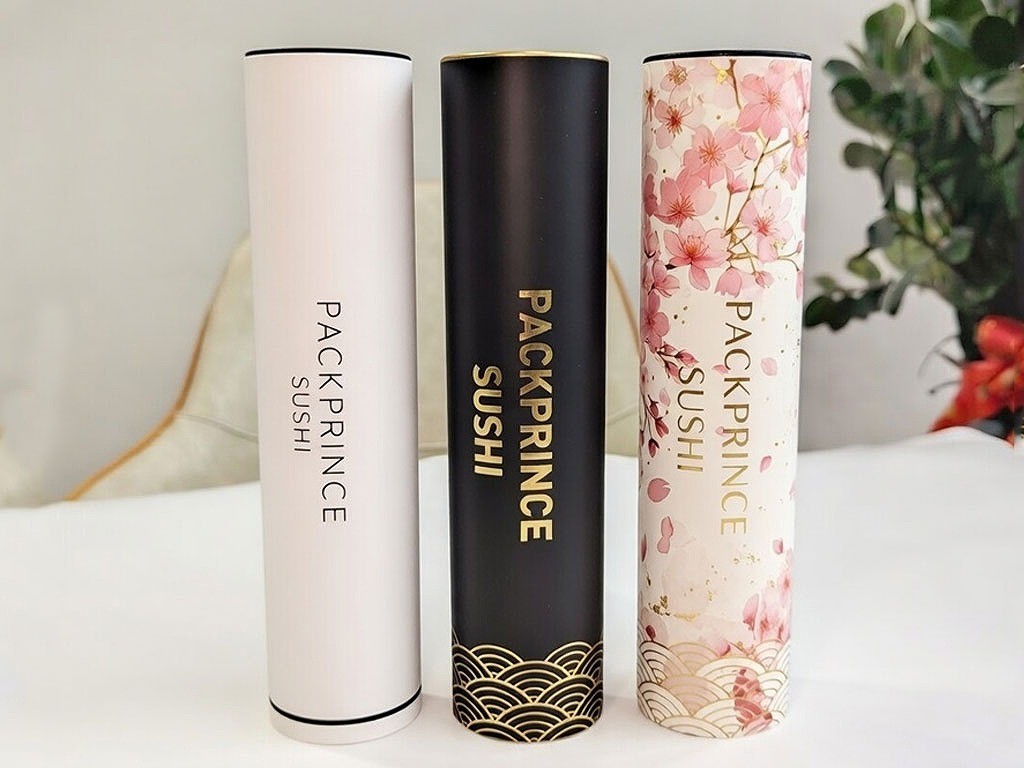
- Vertical presence: Tubes stand upright and look more noticeable than flat packaging.
- 360° brand storytelling: Full-wrap design increases recognition from any angle.
- Premium feel: A well-finished sushi paper tube can elevate perceived quality.
- Shareable unboxing: The push-up motion creates “moment marketing.”
DHPBOXES design tip: If your goal is more orders, keep the tube branding clean and high-contrast. Prioritize logo readability at 1 meter distance, and reserve detailed storytelling for a secondary panel or QR area (optional).
7) Operations & Logistics: The B2B Reality Check
Great packaging must also fit daily operations. Here’s how tubes and boxes compare in back-of-house and logistics planning:
Speed of service
Tubes can be efficient for single-item SKUs once staff are trained. Boxes remain faster for multi-item sets.
Storage & staging
Boxes stack flat. Tubes require upright or partitioned storage. Many brands stage tubes as a “display zone.”
Delivery handling
Tubes are stable for single rolls. For delivery bundles, protective outer cartons and separators can optimize stability.
Product integrity
Both can protect well when engineered correctly. The key is inner structure design to prevent movement and deformation.
At DHPBOXES, we help brands run a pilot smoothly by aligning packaging structure with their selling method. This includes material selection, internal mechanism tolerance, and assembly training guidance.
8) Cost vs Value: The Decision Most Brands Miss
Traditional sushi boxes usually win on unit cost. Sushi push tubes often win on value per impression and value per experience. A smart B2B buyer compares:
- Unit cost vs incremental profit from higher add-on rate or premium pricing
- Brand exposure per order (how often your packaging is seen in public)
- Customer satisfaction (portability, convenience, reduced mess)
- Marketing efficiency (UGC content that reduces paid marketing dependency)
Practical approach: Use tubes for the SKUs that you want to “sell harder” (signature roll, seasonal roll, store-launch item). Keep boxes for assortments, catering, and classic service flows.
9) Buyer Decision Tool: Tube vs Box Scorecard
Use this simple scorecard to choose the right format for a specific SKU. Rate each factor from 1 (low) to 5 (high). If your total for “On-the-go + Marketing” is high, sushi push tubes usually outperform.
| Factor | Score (1–5) | Why it matters |
|---|---|---|
| Takeaway / mobile eating frequency | __ | Tubes are designed for movement and one-hand use |
| Need for premium positioning | __ | Premium packaging can justify premium pricing |
| Social / shareability importance | __ | Interactive formats encourage posting and conversation |
| SKU complexity (multiple items/compartments) | __ | Boxes may be better for assortments and multi-compartment needs |
| Operational speed requirement | __ | Both can be efficient; training and SOP design matter |
Related DHPBOXES resources (internal)
Explore more solutions and guides: Custom Paper Tube Packaging · Food-Grade Packaging Boxes · Custom Printing & Finishes
10) DHPBOXES Factory Specs & Food Safety (SUKA Sushi Supplier)
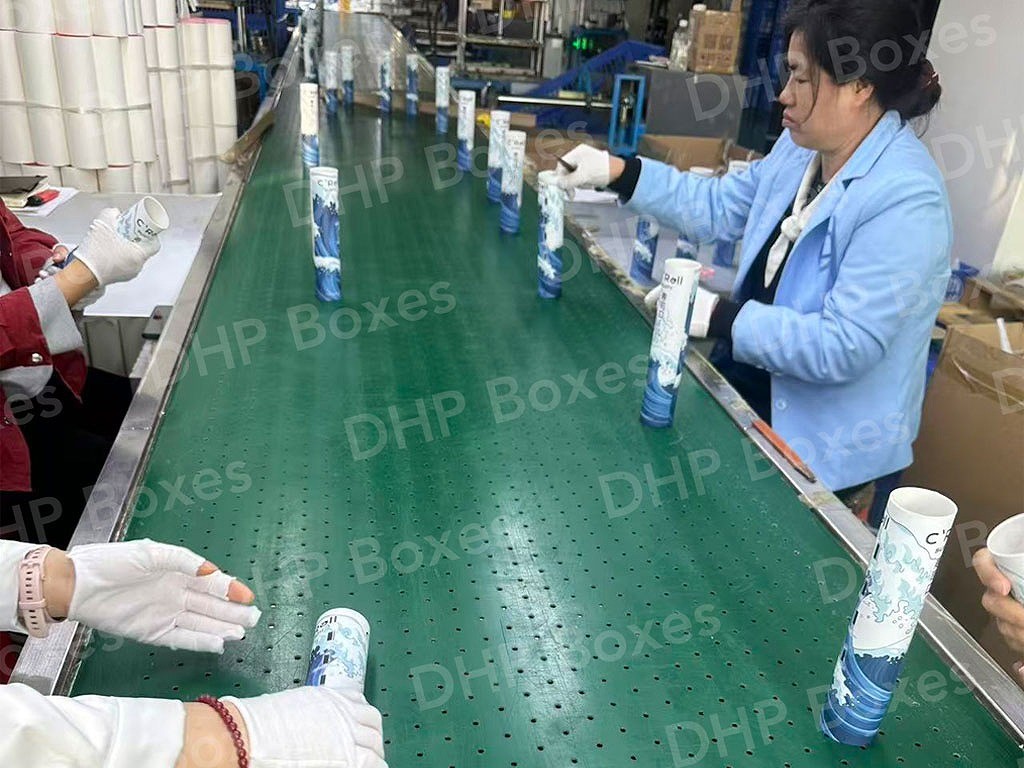
DHPBOXES manufactures sushi push tubes with a focus on brand execution, functional reliability, and food safety. We are a supplier for SUKA Sushi in China, supporting consistent production for growing demand.
Core specifications
- Mold size: 210mm × 51mm
- MOQ: 1000 pcs
- Printing: Custom CMYK (full wrap supported)
- Structure: Push-up inner mechanism engineered for smooth movement
Food safety & compliance
- Certification: BRC food-grade compliance
- Materials: Food-grade certified materials used for production
- Quality approach: Batch consistency checks and production control
- Usage: Designed for sushi rolls and on-the-go consumption
If you want to test this format, our recommendation is to pilot with 1–2 signature SKUs first. We can support sample development and production readiness so your launch looks professional and performs reliably.
11) Frequently Asked Questions
Is sushi push packaging food-safe for brand use?
Yes. DHPBOXES produces sushi paper tube packaging using BRC food-grade compliant materials and processes. If you have specific market requirements, we can align the material and production documentation accordingly.
What is your minimum order quantity?
MOQ starts from 1000 pcs. This is suitable for brand pilots and for scaling once the format is proven.
Do sushi push tubes replace traditional boxes completely?
Most brands use both. Tubes often perform best for takeaway-driven SKUs and marketing campaigns, while boxes remain ideal for assortments, catering, and classic dine-in presentation.
Can you customize size and design beyond the standard mold?
The standard mold size is 210mm × 51mm. For special needs, we can discuss customization options, including structural adjustments, branding layouts, and production feasibility based on your order plan.
What should I prepare to request a quote?
Share your target quantity, desired branding (artwork file if available), sales channel (takeaway / retail / delivery), and your timeline. DHPBOXES can propose a structure and production plan that supports both sales performance and operational reality.
Ready to Test Sushi Push Packaging for Higher Sales?
DHPBOXES is a trusted sushi paper tube manufacturer and long-term supplier for SUKA Sushi in China. All materials follow BRC food-grade compliance. MOQ from 1000 pcs. Welcome to contact us for a custom quote and sampling plan.